Paint Protection Film vs Ceramic Coating: What Is the Difference?
· By Diego C. Mariano
If you have started shopping around for ways to protect your car’s paint, you have almost certainly run into two options that sound like they do the same thing: paint protection film (PPF) and ceramic coating. They both promise to keep your finish looking new, they are both applied by a detailer, and they both cost more than a simple wax. So it is easy to assume you just pick the cheaper one and move on.
That is a mistake. PPF and ceramic coating protect against very different threats. One is a physical shield against impact, the other is a chemical shield against staining and dullness. Understanding the difference is the only way to spend your money on the protection your car actually needs. Below we break down what each one is, what it defends against, what it costs, how long it lasts, and why a lot of drivers around Newark, NJ end up using both together.
What Is Paint Protection Film (PPF)?
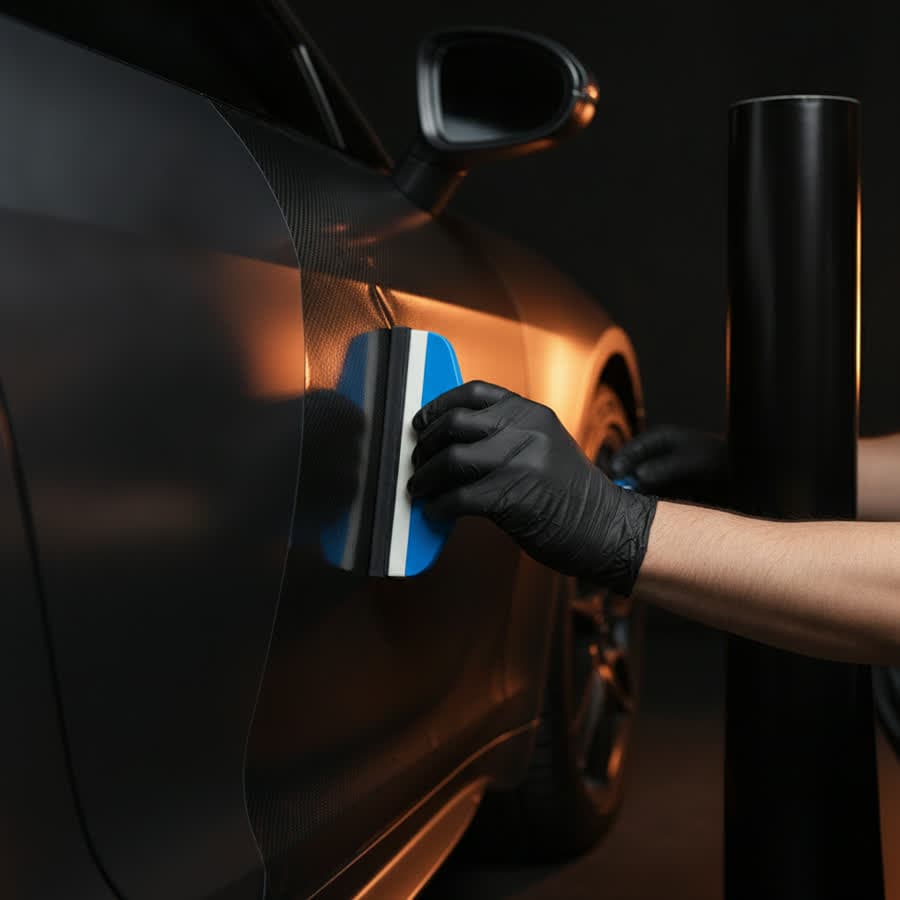
Paint protection film, sometimes called a clear bra, is a thick, transparent thermoplastic urethane film that gets carefully applied over your car’s painted panels. Think of it as a durable, invisible skin laid on top of the paint. It is measured in mils (thousandths of an inch), and quality PPF typically runs around 6 to 8 mils thick, which is dramatically thicker than any coating.
Because it has real physical thickness, PPF absorbs impact. When a rock kicks up off the highway or a shopping cart grazes your door, the film takes the hit instead of your paint. Many drivers install it only on the high-impact zones (the hood, front bumper, fenders, side mirrors, and the leading edge of the roof), while others wrap the entire vehicle. It is the same category of product used to protect the paint on race cars and exotics.
What Is Ceramic Coating?
Ceramic coating is a liquid polymer, usually based on silicon dioxide (SiO2), that chemically bonds to the clear coat of your paint. Once it cures, it becomes a hard, glass-like layer. Unlike PPF, it is extremely thin, measured in microns rather than mils, so it adds almost no physical thickness at all.
What a coating does is change the surface behavior of your paint. It makes the surface hydrophobic, so water beads up and rolls off, carrying dirt with it. It resists chemical staining from bird droppings, tree sap, bug guts, and hard water spots. It blocks UV rays that fade and oxidize paint over time. And it delivers a deep, slick, mirror-like gloss that makes the car look freshly detailed for far longer. What it does not do is stop a rock chip, because it is too thin to absorb any real impact.
What Each One Protects Against
This is the heart of the PPF vs ceramic coating question, so it is worth being precise. PPF is your defense against physical damage: rock chips, road debris, sand blasting on the highway, light scratches, scuffs, and even some door dings. If your biggest worry is the front end of your car getting sandblasted on I-78, PPF is the answer.
Ceramic coating is your defense against chemical and environmental damage: acidic bird droppings that etch the clear coat, UV fade, water spots from sprinklers and rain, road grime, and the general loss of gloss that comes with age. It also makes washing far easier because contaminants struggle to stick. The two are not competitors so much as they cover completely different gaps.
Self-Healing: A PPF-Only Trick
One of the most impressive features of modern PPF is that many premium films are self-healing. The top layer of the film is designed so that light swirl marks and fine scratches disappear when exposed to heat. Park in the sun on a warm day, or pour warm water over the panel, and those small marks vanish as the film reflows back to smooth.
Ceramic coatings do not do this. A coating is hard and scratch-resistant, but if it does get marred, it stays marred until it is polished or reapplied. So if you want a finish that can literally recover from minor surface scratches on its own, that capability lives entirely on the PPF side.
Cost and Longevity
PPF is the more expensive of the two because it is a labor-intensive install: the film has to be precisely cut and hand-fit to every curve of every panel. A partial front-end package costs less than a full-vehicle wrap, and pricing varies widely by vehicle size, film brand, and how much coverage you choose. Quality PPF commonly lasts around 7 to 10 years before it needs replacing.
Ceramic coating is generally more affordable per application because it is a liquid product with a faster process, though professional multi-layer coatings still require serious paint prep to do right. A professionally applied coating typically lasts several years, often in the two to five year range depending on the product and how the car is maintained. Consumer spray sealants last only months. Because prices swing so much with vehicle size and package, the honest answer on exact cost is to get a quote for your specific car. Reach out to Diego’s Pro-Tinting for a free estimate rather than trusting a one-size-fits-all number online.
Can You Combine PPF and Ceramic Coating?
Yes, and for a lot of drivers this is the ideal setup. The two products stack beautifully. You apply PPF first to the impact-prone areas (or the whole car), then apply a ceramic coating on top of everything, including over the film itself.
Doing both gives you the best of each world: the film stops rock chips and scratches, while the coating on top adds hydrophobic, easy-clean properties, extra gloss, and UV and stain protection to both the bare paint and the film. Coating the PPF also helps keep the film cleaner and can extend its life. It is the most complete protection package available, which is why it is popular on new cars and anything the owner plans to keep for a long time.
Which One Should You Choose?
Choose PPF if your main concern is physical damage: you drive a lot of highway miles, you park in busy lots, you have a new or high-value car, or you have already had to touch up rock chips on a previous vehicle. It is the only product here that physically stops chips and scratches.
Choose ceramic coating if your main concern is keeping the car glossy, clean, and easy to wash, and protecting against bird droppings, water spots, and UV fade. It is the better value if you are not worried about impact and just want your paint to stay showroom-fresh with less effort. And if you want it all, combine them. During a consultation at Diego’s Pro-Tinting in Newark, NJ, we look at how you drive and where you park so the protection actually matches your situation instead of overselling you a package you do not need.
Maintaining Your Protection
Neither product is truly maintenance-free. For ceramic coating, wash the car regularly with a pH-neutral car soap and the two-bucket method to avoid dragging grit across the finish, and skip automatic brush car washes that can scratch the surface. A yearly inspection helps confirm the coating is still performing, and top-up sprays can refresh the hydrophobic effect between applications.
For PPF, keep it clean the same gentle way, and rinse off bird droppings and bug residue promptly since they can stain the film if left to bake in the sun. Avoid pressure-washing directly at the film edges. Both products reward a little consistent care with years of protection, which is a big part of why they are worth the upfront investment.
Frequently asked questions
- Is PPF or ceramic coating better?
- Neither is universally better because they solve different problems. PPF is better at stopping physical damage like rock chips and scratches, while ceramic coating is better at repelling water, resisting stains and UV fade, and adding gloss. For full protection, many drivers use both together.
- Does ceramic coating protect against rock chips?
- No. Ceramic coating is only microns thick and cannot absorb impact, so it will not stop rock chips or deep scratches. If chip protection is your goal, paint protection film is the product you need.
- How long does paint protection film last?
- Quality professionally installed PPF commonly lasts around 7 to 10 years before it needs replacing. Longevity depends on the film brand, how the car is driven, and how well it is maintained.
- Can you put ceramic coating over PPF?
- Yes. Applying a ceramic coating on top of PPF is a popular combination. The coating adds hydrophobic, easy-clean, and gloss benefits to the film, can help keep it cleaner, and may extend the life of the film underneath.
- How much does PPF or ceramic coating cost?
- Pricing varies widely based on vehicle size, the product used, and how much coverage you choose, so there is no single accurate number. The best way to know is to get a free estimate for your specific vehicle from Diego’s Pro-Tinting.
Related services
Serving
Found this helpful? Make us a preferred source on Google.
Ready for an exact price?
Get a free, no-pressure in-home estimate. Real numbers for your home, not a phone guess.